Haverhill, Massachusetts · Water treatment

Water treatment made personal.

Tell us what you notice about your water. We test, explain your options in plain words, and install only the system that fits your home.

Clear answers. Careful planning. Help after the install.

  • Whole-home systems

    Treated where water enters

  • Drinking water

    Its own tap at the sink

  • After the install

    Filter and care guidance

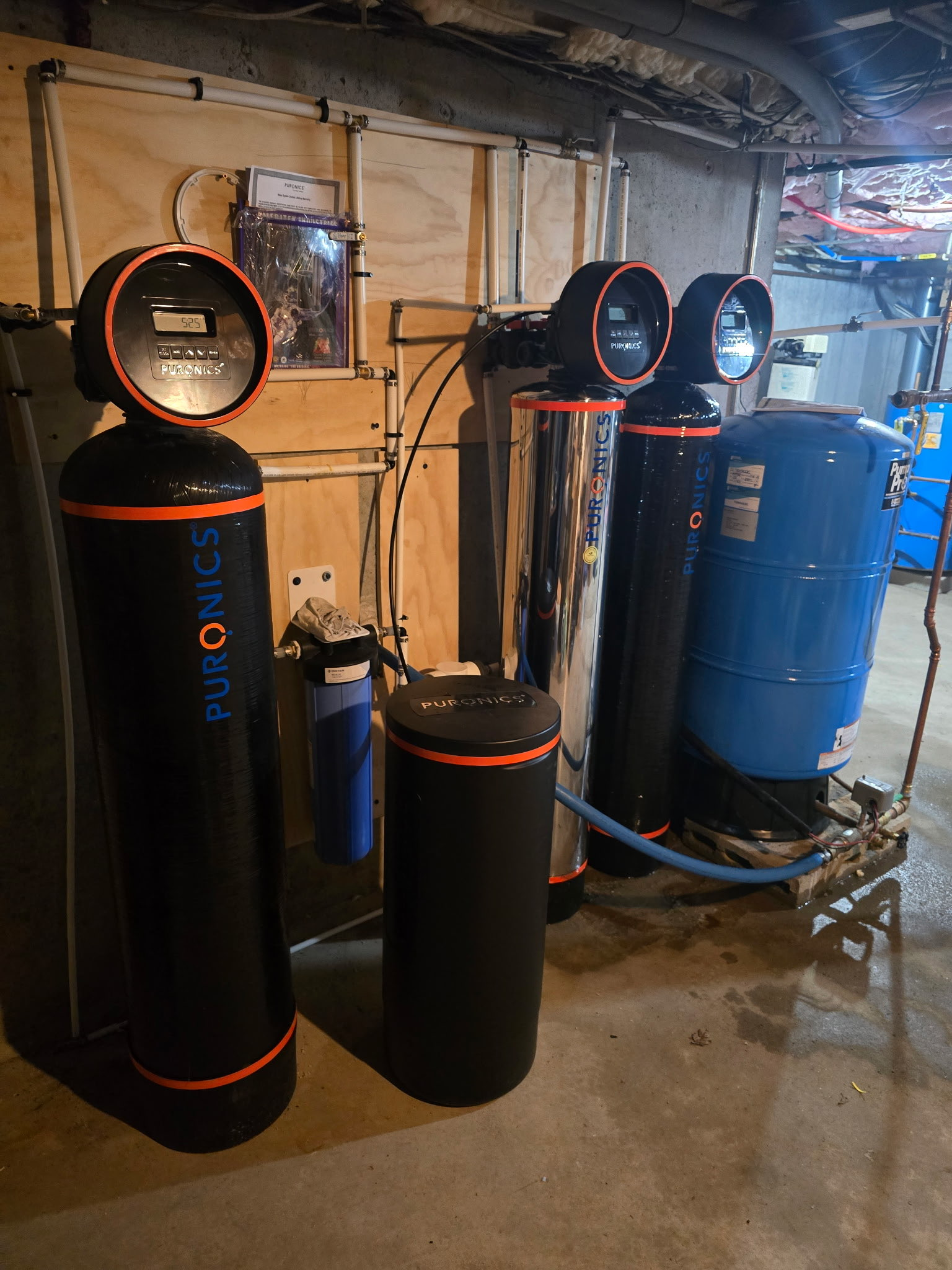
Multiple installed Puronics water treatment tanks with orange trim and digital control heads in a residential basement, connected to copper and PVC plumbing.

Softening · Filtration · Reverse osmosis

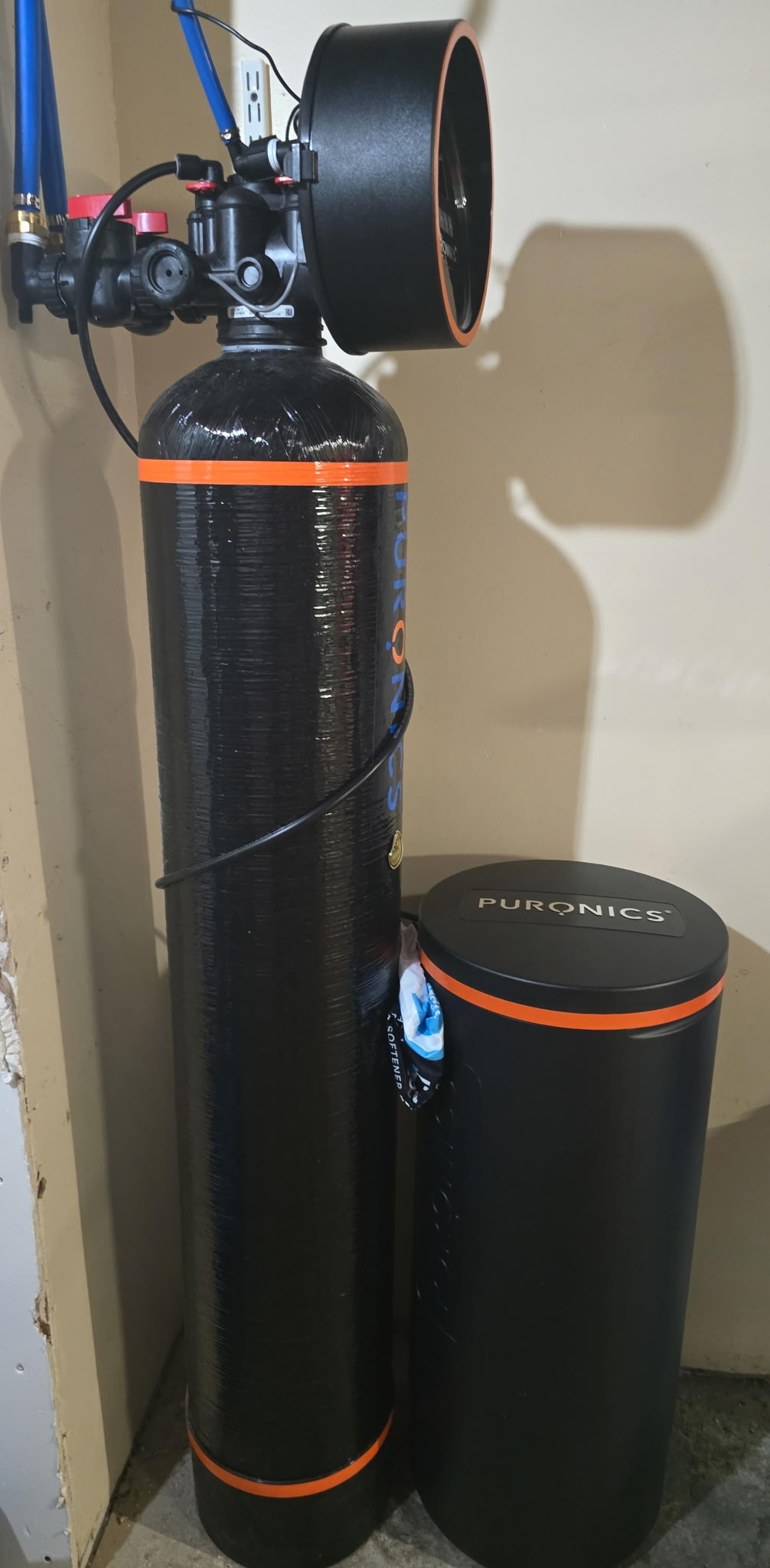
Close view of a black Puronics filtration tank with an orange band, control valve, and brine tank in a home utility area.
Real installs, Haverhill area

In everyday life

What the right water treatment can change at home

A good system is not dramatic. You notice it in small daily things — when the treatment is matched to the water you actually have.

The first thing people notice

Water feels different to use

Hard-water minerals and leftover chlorine or chloramine can leave some people feeling dry or tight after a shower. The right treatment may make water feel gentler on your skin. We do not treat skin conditions.

  • Hair

    Mineral buildup and disinfectant residue can leave hair feeling coated, dull, or hard to rinse. Reducing those causes may help. No cosmetic result is guaranteed.

  • Drinking more often

    When water tastes and smells better, it is easier to reach for all day. That is about taste — filtering water does not change how your body works.

  • Cooking, coffee, and ice

    Less chlorine taste carries into coffee, tea, soup, rice, and the ice from your fridge.

  • Less scale and soap film

    Treat hardness properly and you usually see less crust on faucets, fewer spots on glasses, and softer-feeling laundry. Hardness is a mineral issue — not a contaminant.

  • Easier on the house

    Less sediment and scale may mean less buildup in your pipes, water heater, and appliances. How much depends on your water and the system.

  • Knowing where you stand

    You will know what was tested and what your model is documented to reduce. That is worth more than a general promise.

Microplastics in bottled water and tap water

Microplastics have been found in both bottled water and tap water, so a sealed plastic bottle is not automatically the purer choice. A properly selected home filter—especially a drinking-water system using fine filtration or reverse osmosis—can reduce these particles and give your family an alternative to relying on plastic bottles. Results depend on particle size and the exact system; no filter should be presented as removing every microplastic.

Now let's look at what you're noticing

Continue to “Your water”

Your water

What are you noticing at home?

Pick the one that sounds closest to your home. This is just a starting point for the conversation.

A starting point

Spots, scale, soap

Hard-water buildup

White crust, spotty glasses, and soap that will not lather usually point to hard-water minerals. A softener is one option. We look at your water and your plumbing first.

See how we plan it

These are general starting points, not recommendations. The right system depends on your water, your plumbing, and the model you choose.

Before choosing equipment

A city report is a starting point — not a test of your tap

  • City reports show what was found in the public system, not what comes out of your faucet.
  • Your water can also be affected by a private well, the pipe to your house, your home's plumbing, and the season.
  • We start by finding the real concern, then check what the model you are considering is documented to do.
  • City water reports do not usually list microplastics. If they concern you, compare drinking-water filtration options and the exact model's documented particle-reduction information.
Check your Massachusetts water

EWG is an independent outside database built from utility test data that is already public. It is not a test of your home, and it does not mean EWG works with Rio y Vida.
Optional

Lab-verified purity, in writing

Ask about optional certified-lab testing and the written purity guarantee. A sample of your water can be sent to a certified lab before treatment to find the concern, and again afterward to check the result, depending on the service you agree to.

  • You get the lab results in writing for the substances included in the test panel you choose.
  • The guarantee covers only the analytes, limits, sampling method, and terms written in that panel.
Ask about lab testing

One test cannot prove water has no contaminants at all, and it does not mean every possible substance was checked. What is verified is what the written panel covers.

Systems for the home

Four kinds of treatment, four different jobs.

Filtering, softening, drinking water, and well or problem water each fix something different. Once you know which one you need, the rest gets simple.

Not every home needs all four. Most need one or two.

  • 01

    Whole-home filtration

    One system where water enters your house. It uses filter media — the material water passes through — to work on taste, odor, sediment, or another specific concern, depending on the model.

    Best conversation starter

    “The water tastes or smells off everywhere in the house.”

  • 02

    Water softening

    A softener uses ion exchange: hard minerals in the water swap places with a small amount of salt or potassium inside the tank. That is what lowers hardness. Salt or potassium is refilled as needed.

    Best conversation starter

    “There is scale on my fixtures and soap does not lather.”

  • 03

    Drinking-water filtration

    Reverse osmosis pushes water through a very fine membrane in several steps. It sits under the sink and feeds its own small tap for drinking and cooking.

    Best conversation starter

    “I mainly care about what we drink and cook with.”

  • 04

    Problem and well-water treatment

    Iron, sulfur smell, sediment, and acidic or high-pH water each need a different answer. We look at the water and the source before choosing equipment.

    Best conversation starter

    “We are on a well and the water changes through the year.”

Black Puronics whole-home filtration tank with an orange band and control valve installed beside a brine tank in a home utility area.
Whole-home system and brine tank, utility area install.

About “no-salt” systems

No-salt filtering or conditioning is not the same as removing hardness. Only a conventional softener removes hardness minerals. If that is your goal, ask which system actually does it.

Technology

What the technology actually does for you.

A Puronics system has two main parts: a smart control on top and the filter media inside. Here is what each part means for your water.

How water moves through the system
Water comes inThrough the mediaSmart controlWater to your taps
  • iGen® smart control

    It watches how much water your household uses and cleans the media based on that, instead of on a fixed clock. Less waste, less guesswork.

  • Media chosen for your water

    Media is the material inside the tank that water flows through. Which media goes in depends on your water and the model — not one setup for everyone.

  • ChloroShield® media

    Made to reduce chlorine and chloramine, the taste and smell many people notice from city water. Offered in selected systems only.

  • SilverShield® protection

    Made to keep bacteria from growing inside the filter media, so the media stays clean between services. It does not sterilize the water in your home.

Inside a reverse-osmosis drinking-water system

Water passes through four steps before it reaches your drinking tap.

  1. 1

    Sediment prefilter

    Catches grit and particles.

  2. 2

    Activated carbon

    Works on chlorine taste and odor.

  3. 3

    RO membrane

    The fine layer that does the main work.

  4. 4

    Final stage

    Polishes the taste before the tap.

What a system does depends on the model you choose, your water, and keeping up with maintenance.

Installation

What installation day looks like.

You should know what is going in, where it goes, and how to care for it — before anyone picks up a tool.

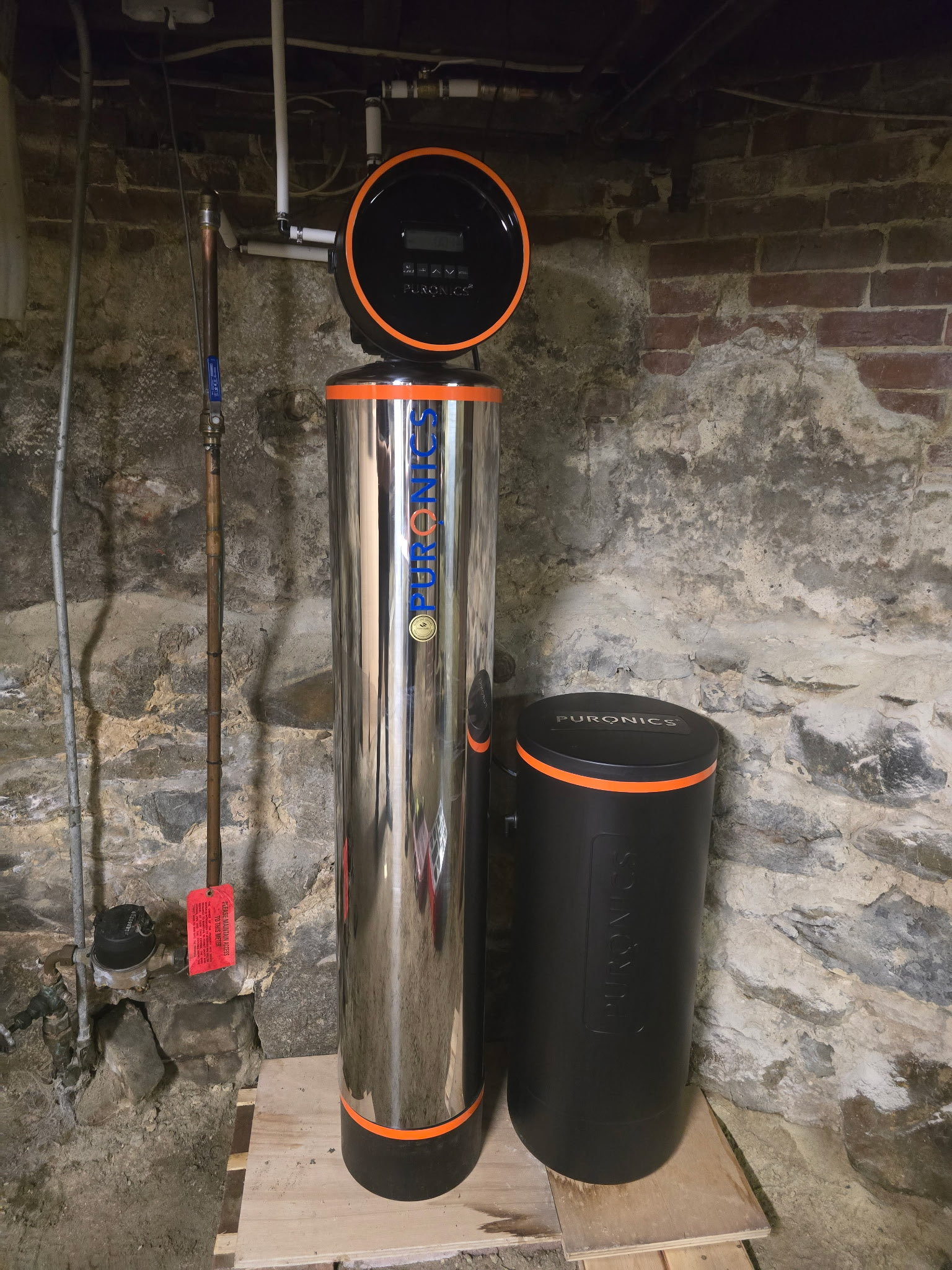
Stainless steel Puronics tank with orange trim and a digital control head installed on a plywood base against a fieldstone basement wall.
Stainless tank and brine tank set on a level base, stone-wall basement.
Black Puronics tank and brine tank installed in a corner utility space with a control valve, bypass, and blue supply lines overhead.
Bypass valve and lines left easy to reach for service.
Multiple installed Puronics tanks with orange trim and digital control heads connected to copper and PVC plumbing in a basement.
A multi-system layout with the controls kept in plain view.
  1. 01

    We start with your home and your water

    What you notice, where your water comes from, and how your household uses it. You leave this step knowing what we are trying to solve.

  2. 02

    We compare your options side by side

    You see the systems that fit, how much space each one needs, and the paperwork that shows what each model is documented to do.

  3. 03

    We plan the practical details

    Where the equipment sits, the bypass valve, the drain, power if needed, and room to service it later. You will know exactly where it goes before install day.

  4. 04

    We install it and show you the controls

    The system is set, plumbed, and started up. Then we stand at the control with you and go through the buttons you will actually use.

  5. 05

    We explain care and what comes next

    What upkeep your system needs, which filters or salt it uses, and how to reach us with a question later.

Certifications

Product certifications and registrations, explained.

There are two different things here. Certification means an outside group tested a product and confirmed a specific claim. Registration means a product's label is on file with the government. Both apply to named products — never to a whole brand.

  • Water Quality Association Gold Seal certification mark

    WQA Gold Seal

    A certification. The Water Quality Association tests a product and confirms a specific claim. Selected Puronics models carry it. Ask which listing covers your model — the listing names the NSF/ANSI standard and the exact claim.

  • NSF certification mark

    NSF/ANSI standards

    Also a certification. Each standard covers a different job: 42 for taste and odor, 44 for softeners, 58 for reverse osmosis, 372 for lead-free materials. Selected models are certified to some of these — not every system carries every one.

  • United States Environmental Protection Agency seal

    EPA-registered bacteriostatic media

    This is a registration, not a certification. Selected Puronics systems and media with SilverShield® HYgene® contain an EPA-registered bacteriostatic product. It is about keeping bacteria from growing inside the filter media. It is not an EPA endorsement, and it does not mean your home's water is sterilized.

  • EPA registration under FIFRA

    FIFRA is the federal law behind that registration. It has no seal for shoppers, so what you see here is the record itself: the EPA label for "Bacteriostatic Water Conditioner with HYgene," EPA Reg. No. 35900-3. It covers that specific media and its labeling — not Rio y Vida.

    View EPA record

What to ask for

  • The exact model name
  • The exact claim it is certified for
  • What upkeep it needs
  • How much space it takes

These marks and registrations apply only to the specific products or media named in their official records — not to Rio y Vida as a company.

What a system is certified to reduce depends on the model. Ask for the product data sheet for the exact system you are considering, and we will go through it with you.

Practical questions

Questions homeowners actually ask.

  • A softener lowers hard minerals using ion exchange. A filter uses media to work on things like taste, odor, or sediment. They fix different problems, and some homes need both.

Get in touch

Start with the water in your home.

You do not need to know which system you need. Tell us what you notice and we will start there — no pressure, no rush.

Haverhill, Massachusetts · Serving nearby communities.

Optional. Anything else about your home or your water that would help us.